

How to Make a Career Change at 40 Without Starting Over
For a lot of people, a career change at 40 comes wrapped in fear. Fear that they somehow failed at life. That here they are in their middle years, facing big change they did not plan for. I coach people through exactly this, and here is what I actually watch happen: that fear turns into a re-entry of excitement. New opportunities. Broader horizons. A career change at 40 is not a restart, and it is not a failure. It is a transfer of everything you already know into work that finally fits your life.
Why 40 is a transfer, not a restart
Midlife is one of the most common times to change direction, and it is also one of the most advantageous. By 40 you know how organizations work, how to manage people and pressure, and what you are actually good at. That knowledge does not reset when you change fields. It compounds.
Here is the honest part. A change at 40 will cost you something in the short term, comfort, a title, sometimes income for a season. But the bigger risk is rarely changing too late. The bigger risk is staying too long in a role you have already outgrown, telling yourself it is too late, until one day the choice gets made for you.
Here is the pattern I see in the people I coach through this. They arrive with two decades of experience, and it changes everything. They know what they want and what they do not want. They understand people better. They understand their industry. So they stop accepting a job and start choosing a career that matches their life. That shift is enormous. The people who take this moment in their 40s to transfer what they have built are not looking for a nice way to close out a career. They are setting up the season where they make their biggest difference, the part they will one day point to as their legacy.

A career change at 40 is not a restart. It is a transfer of everything you already know into a place that fits you better.
You are not accepting a job anymore. You are choosing a career that matches your life. That is a legacy move, not a last resort.
Start with clarity, not a resume
Most people begin a career change by updating their resume and scrolling job boards. That is starting in the wrong place. You end up chasing openings instead of choosing a direction, and you talk yourself out of moves before you understand them. Clarity comes first.
Find the thread
Look back at the work that energized you, not just the roles you held. There is usually a thread: the kind of problem you like solving, the type of people you like serving, the environment where you do your best work. That thread matters more than any single industry.
Test before you leap
Clarity is not something you wait to feel. It is something you build by testing. Talk to people who do the work you are considering. Take on a small project, a volunteer role, or a side engagement. A few real conversations will tell you more than a month of overthinking.
Take inventory of what actually transfers
Before you decide you are unqualified for the new path, list what you already carry. Most professionals badly underrate their transferable skills because those skills feel ordinary after years of use.
- Leadership and people skills: managing, mentoring, resolving conflict, building trust
- Communication: writing, presenting, selling an idea, handling hard conversations
- Judgment: prioritizing, making decisions with limited information, managing risk
- Domain knowledge: how your industry works, who the players are, what customers actually want
- Relationships: a network that took twenty years to build and does not disappear when you change fields
If you want the fuller version of this, my article on choosing the right kind of coaching covers how these same strengths show up at different levels of leadership.
Build the bridge, do not jump the gap
The all-or-nothing leap is what makes a career change at 40 feel reckless. You rarely need it. A bridge lets you change direction while protecting your footing.
- Close the smallest skill gap first. Identify the one or two credentials or skills the new path actually requires, and start there, not with a full degree.
- Earn proof on the side. A project, a freelance client, or a volunteer role gives you real evidence and a story to tell, before you ever quit.
- Protect your runway. Map the finances. Know your number and your timeline so the change is a plan, not a gamble.
- Move in stages. A lateral step into an adjacent role often beats a dramatic jump. You keep momentum and reduce the drop.
The framework I use with clients
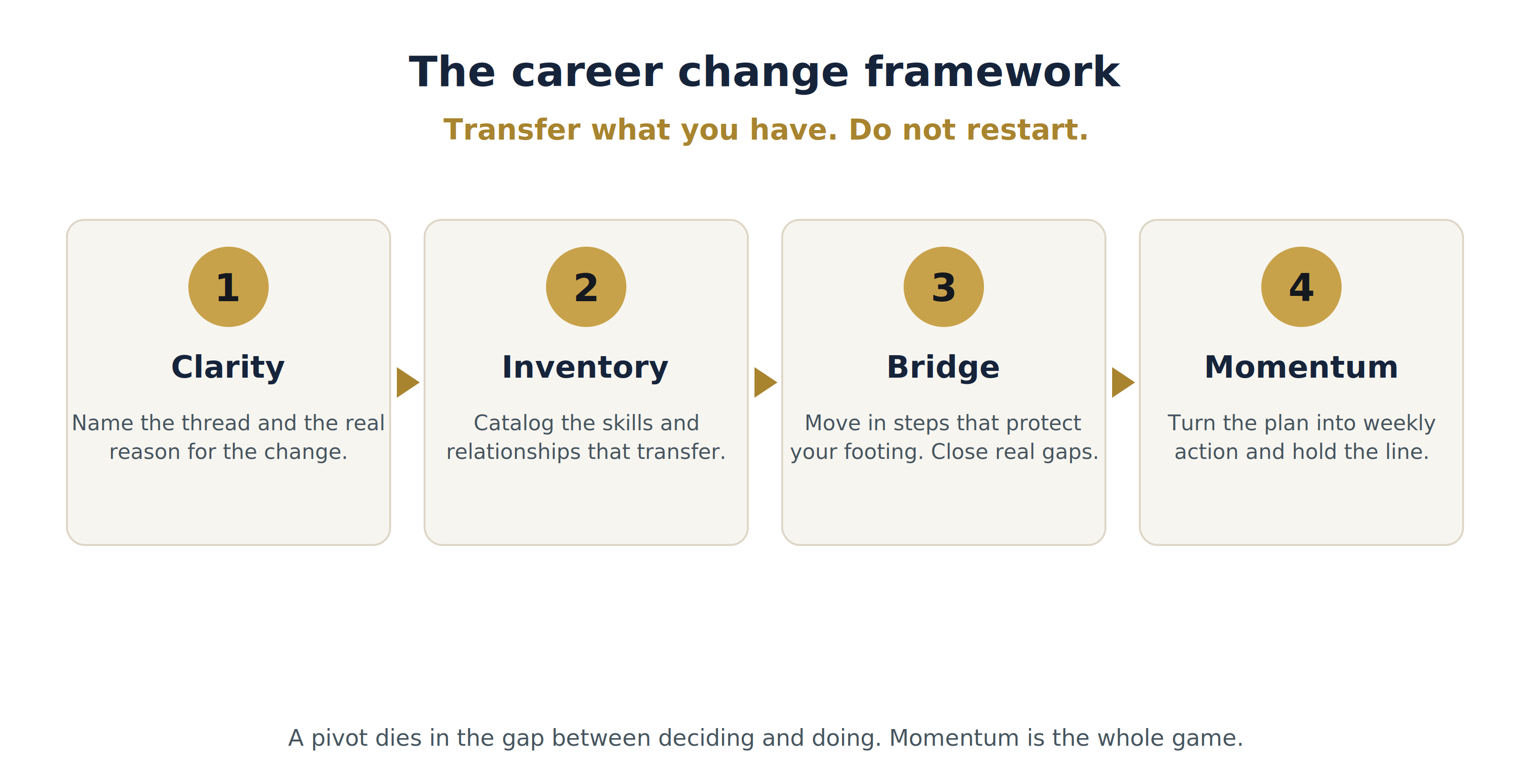
When someone comes to me weighing a change at 40, we do not start with the job market. We start with them. The same four moves sort almost every pivot, and they are the backbone of how the Key2Success Planning System turns a big, scary decision into a sequence of doable steps.
This is the work I do inside the Personal program for people redefining their direction, and the Professional program for those pivoting into a bigger role. Clarity first, then momentum.
The biggest risk at 40 is not changing too late. It is staying too long in a role you have already outgrown.
Signs it is actually time
Thinking about a change but not sure where to start?
Book a free 10-minute call. We will find the thread and map a first step that fits your situation.
Book a free 10-minute callQuick answers
- Is 40 too late to change careers?
- No. Midlife is one of the most common and advantageous times to change, because your experience transfers with you.
- Do I have to take a pay cut?
- Not always. A staged, adjacent move often protects income better than a dramatic leap into an unrelated field.
- Should I go back to school?
- Usually only for the specific skill or credential the new path requires. Start narrow, not with a full degree.
- What if I do not know what I want yet?
- That is normal. Clarity is built by testing, not by waiting to feel certain. Start with a few real conversations.
- How do I explain the change to employers?
- Frame it as a transfer. Connect what you did before to what the new role needs, using your transferable skills.
- Can I change without quitting first?
- Yes. Building proof through side projects or volunteer work before you leave is the safer, smarter path.
- What is the first step?
- Find the thread. Identify the kind of problem and people that have energized you across your whole career.
- How long does a career change take?
- It varies, but a staged change usually unfolds over several months to a couple of years, not overnight.
Frequently asked questions
How do I make a career change at 40 without starting over?
What are the most common career changes at 40?
How do I overcome the fear of changing careers midlife?
What transferable skills matter most for a career change?
Can a coach help with a career change?
How do I know if I am ready to make the change?

Branden Bodendorfer is a business and leadership coach and the creator of the Key2Success Planning System. He coaches professionals through career changes, promotions, and reinventions using a planning framework that turns big decisions into weekly action. See his coaching programs.