

What to Expect From One-on-One Coaching (And When It Is Worth It)
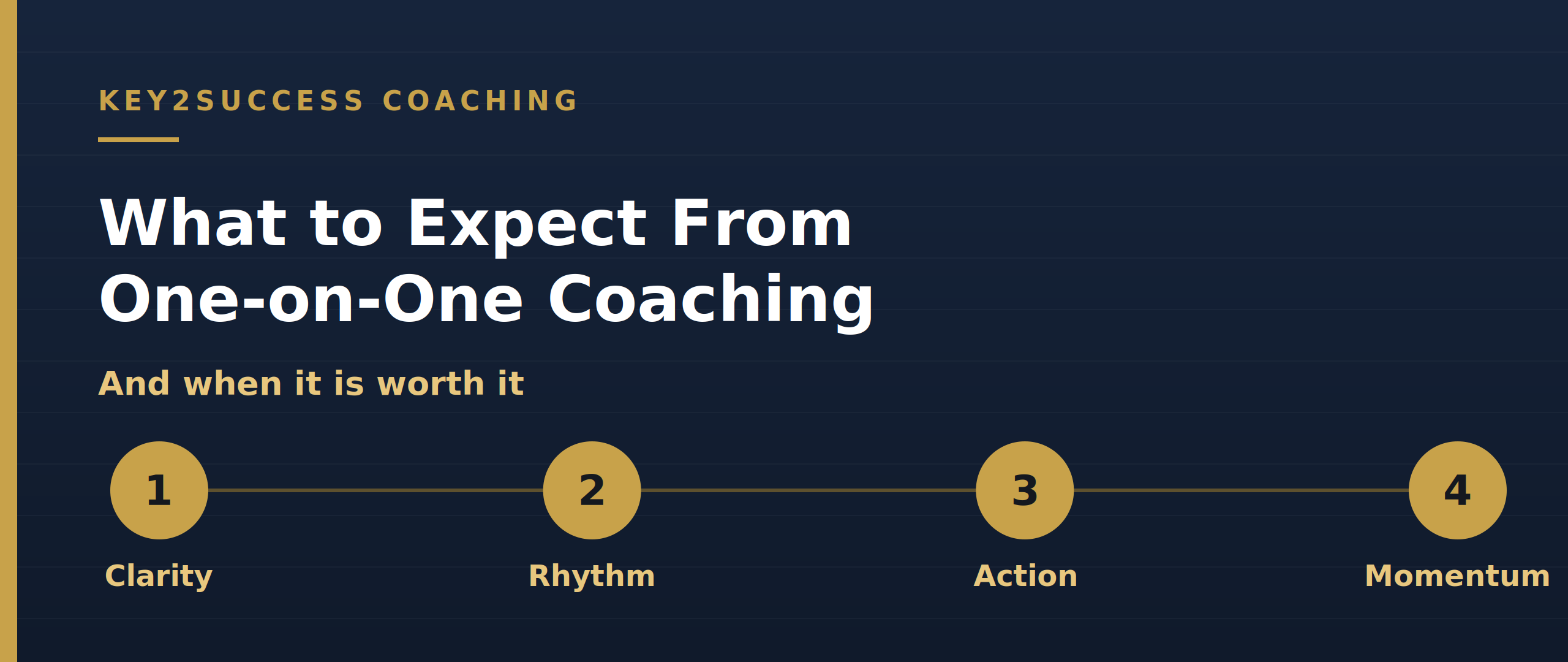
Most people picture coaching as a nice conversation once a week. That is not where the results come from. Coaching does not work in the session. It works between them. After coaching professionals, executives, and business owners through the Key2Success Planning System, the pattern I see is simple: the value is not how good the call feels, it is whether the call turns into action you actually take on Tuesday morning.
What one-on-one coaching actually is
Coaching gets confused with two other things. A therapist helps you heal. A consultant hands you the answer and often does the work for you. A coach does neither. A coach asks the questions that sharpen your own thinking, then holds you to what you said you would do. You leave with your own decision and a plan to act on it, not a report to file away.
That distinction matters, because it tells you what to expect. You are not paying for someone to fix you or to do the work for you. You are paying for clarity, honest feedback, and accountability, applied to the exact goal in front of you.
Coaching does not work in the session. It works between them.

What to expect from a real engagement
A real coaching engagement has a rhythm, not just a calendar invite. Here is what a strong one looks like in practice, and what mine looks like specifically.
- Regular one-on-one sessions. Consistent calls, usually by video, focused on your goals and the decisions in front of you. Location is not a barrier.
- A record you can go back to. In my programs, sessions come with recordings and written summaries, so the insight does not vanish the moment the call ends.
- Work between sessions. The session sets the direction. What you do in the days between is where the change happens. Expect to leave with something specific to act on.
- A planning system, not just talk. My coaching runs on the Key2Success Planning System, so every goal turns into daily and weekly action instead of a nice idea you forget by Thursday.
- Honest feedback. A good coach tells you what you need to hear, not what you want to hear. If you wanted agreement, you could ask a friend.
Where the results actually come from
Here is the part most people miss. The session is not the product. The session is where you get clear and commit. The results come from what happens in the twenty-three hours a day you are not on a call with your coach. That is why the best coaching is judged by what you do on Tuesday, not by how good you felt on the call.
This is also the single biggest reason coaching fails. People love the conversation, feel motivated, and then nothing changes because the insight never became action. Closing that gap is the whole job. It is why I do not just talk, I tie every session to a plan you carry into your week.
The best coaching is judged by what you do on Tuesday, not by how good you felt on the call.
When coaching is worth it
Here is the moment I see land more than any other, with owners, professionals, and entrepreneurs, the whole range. It is when they realize they are not in a room with a counselor or a therapist or a talk-only coach. They are in a room with someone who has been there. Someone who has built businesses, grown sales, brought new products and services to market, made payroll, hired that first employee, and had to let the next one go. I have made the hard pivots and moved on the narrow opportunities, and I am living proof that planning your opportunities out is how you get through them. That is the part people tell me is most worth it. They finally have a partner who gets it, someone willing to walk side by side and help them weigh what each decision could deliver, what it could cost, and where the risk really sits. That is what we do at Key2Success. We walk with you through the process and help you see that your own success is possible.
You are not in a room with a counselor or a consultant. You are in a room with someone who has been there.
Coaching is worth it when two things are true: you are facing real growth or change, and you are willing to do the work between sessions. The return is not magic. It is the difference between figuring something out alone over two years and getting there in two quarters with a thinking partner and a plan.
When it is not worth it
I would rather tell you the truth than sell you a program you will not use. Coaching is not worth it in a few cases, and it is fair to name them.
- You only want validation. If you want someone to agree with your plan, save your money. A good coach will push you.
- You will not do the work between sessions. If the plan never leaves the call, coaching cannot help you. The work is yours.
- You need healing, not goals. If the real issue is mental health, a licensed therapist is the right partner, not a coach.
- You want someone to do it for you. That is a consultant or a hire, not a coach.
What makes coaching stick
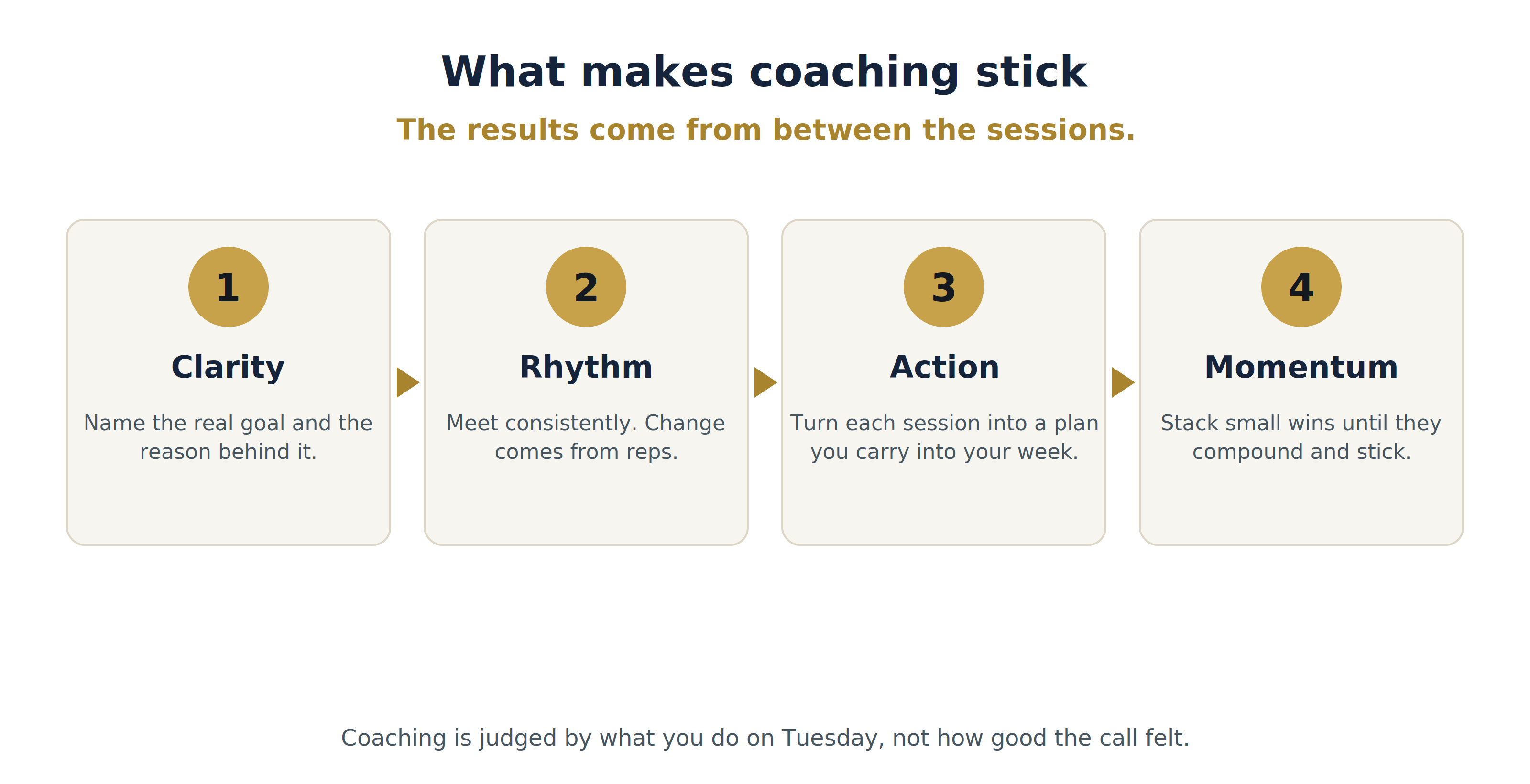
When someone asks me what actually makes coaching work, I point to four things in order. Miss any one and the results leak out. This is the backbone of how I coach across all four programs, from Personal to Business Development.
If you are weighing coaching and want a straight answer about whether it fits your situation, that is exactly what a short call is for. No pressure, just clarity.
If you are not sure which kind of coaching you need, or whether now is the time, see which type of coaching fits your situation and when to hire a coach.
Wondering if coaching is worth it for you?
Book a free 10-minute call. I will give you an honest read on whether it fits your goals right now.
Book a free 10-minute callQuick answers
- How often do coaching sessions happen?
- Usually on a consistent schedule, often weekly or every other week, with work to do in between. Rhythm matters more than frequency.
- Is coaching the same as therapy?
- No. Therapy works on healing and the past. Coaching works on goals and the future. If you need healing, see a licensed therapist.
- Is coaching the same as consulting?
- No. A consultant gives you the answer. A coach builds your own ability to find and act on it.
- Do sessions happen in person?
- My programs run by video with recordings and summaries, so where you live does not limit the work.
- How long until I see results?
- Most people commit to two or three quarters, because changing habits and hitting real goals takes consistent reps.
- What do I actually do between sessions?
- You work the plan. Every session should end with something specific to act on, tied to a planning system so it does not slip.
- What if I am not sure coaching is right for me?
- Start with a short call. A good coach will tell you honestly if it is not a fit right now.
- Does coaching guarantee results?
- No honest coach guarantees outcomes, because the work is yours. Coaching raises the odds and the speed, it does not do the work for you.
Frequently asked questions
What should I expect from one-on-one coaching?
Is one-on-one coaching worth the money?
What is the difference between coaching, therapy, and consulting?
How do I get the most out of coaching?
When is coaching not worth it?
How much does one-on-one coaching cost?

Branden Bodendorfer is a business and leadership coach and the creator of the Key2Success Planning System. He coaches professionals, executives, and business owners through growth and change, tying every session to a planning framework so goals turn into daily action. See his coaching programs.