

When Is the Right Time to Hire a Coach?
Most people think you hire a coach when you are drowning. That is one signal, but it is not the only one, and it is rarely the best one. It does not always have to be emotional. After coaching owners, professionals, and executives for years, the pattern I see is that the smartest time to bring in a coach is usually at a decision or a change, not at a breakdown. Waiting until you are underwater just means you paid the price first.
The short answer: watch for the signals
The right time is not a date on the calendar. It is a set of signals. Some are internal and some are external, and the strongest cases usually show more than one. Below are the ones I watch for with every person who comes to me asking whether now is the time.
The emotional signals
These are the ones people notice first. If you feel a steady level of stress, a sense of loss about where to go next, or anxiety from the sheer size of the work stacked in front of you, those are real signals. They tell you the load has outgrown the system you are using to carry it. A coach helps you get organized, get clear, and stop carrying all of it in your head.
The stuck signal: clear goal, no movement
This one is quieter, and it is easy to ignore. You have a firm mental grasp of what you are trying to achieve. You can describe the goal in one sentence. And yet you cannot move the hurdle, you cannot push the mark forward, and months go by with no real progress. That gap between knowing and moving is one of the clearest reasons to bring in a coach. You are not confused. You are stuck, and stuck is a different problem that needs a thinking partner to help you build the plan that finally moves it.

You do not need to be confused to need a coach. Sometimes you know exactly where you are going and still cannot move the mark.
The organizational triggers
Plenty of the signals have nothing to do with how you feel. They are events. When one of these lands on your desk, it is worth asking whether a coach would help you handle it well instead of just handling it.
In each of these, you are looking for someone to help you be constructive in your thinking, and to help you build a plan that maximizes your potential through organizing a real process change. A good coach walks alongside you. They do not just have experience in the problem you are solving, they have the wisdom to show you what the results can actually look like.
The decision point, the biggest signal
The most common signal I see is a decision. Not a small one, the kind that can have a real impact on your organization and your professional goals. Here is what most people miss about big decisions: they are never just one decision. Every decision you make leads to another decision. You are not choosing a single outcome, you are starting a chain.
That is exactly where a strong coach earns their place. A coach helps you work through the decision itself, and then helps you track the metrics and KPIs so you can see that this choice led to that result. They help you understand your own risk tolerance, and they help you spot where you might need to pivot as the path unfolds. You are not just making a call, you are learning how your calls play out, which makes the next one better.
Every decision you make starts a journey of process change. A coach helps you see where each one takes you.
This is the mindset we encourage with every member. Be aware that every decision starts a journey. Be open to your success, because a decision is almost always about growing you or your organization. And growth brings its own challenges, bigger problems and bigger wins, that will ask you to adapt your process again. A coach is the partner who helps you keep adapting instead of stalling.
The four signals, in one place
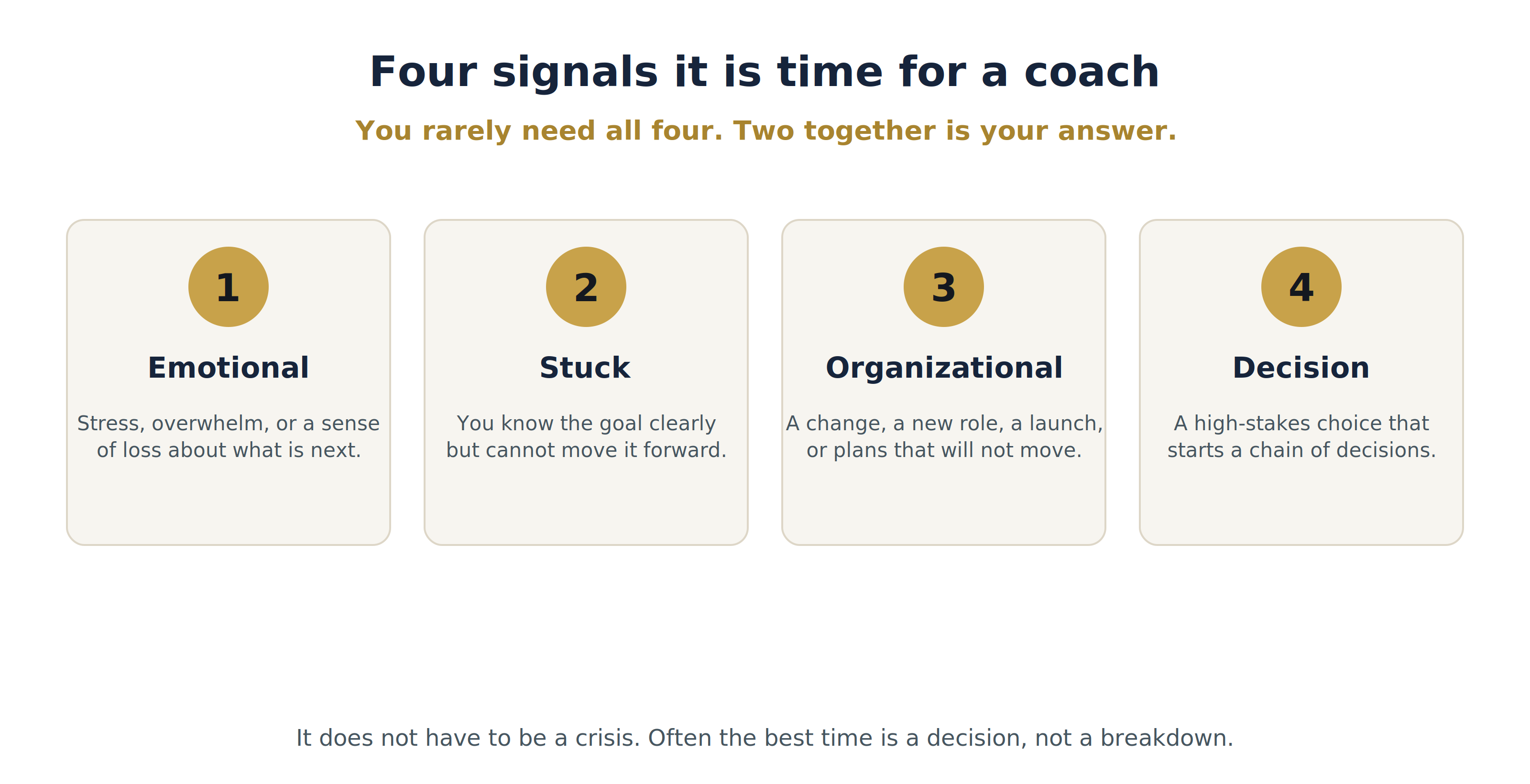
When someone asks me whether it is time, I walk them through four signals. You rarely need all four. Two showing up together is usually your answer. This is the same lens we use across all four coaching programs, from Personal to Business Development.
Not sure whether what you are feeling counts? That is exactly what a short call is for. If you want a second opinion, you can also read what to expect from coaching and which type of coaching fits your situation.
Seeing one or two of these signals?
Book a free 10-minute call. I will give you an honest read on whether now is the right time for you.
Book a free 10-minute callQuick answers
- Do I need to be in crisis to hire a coach?
- No. A crisis is one signal, but a decision, a change, or a stalled plan are often better and earlier times to start.
- Is a new role a good time to get a coach?
- Yes. New altitude means new skills. A coach shortens the learning curve and helps you start strong.
- What if I know my goal but cannot move it?
- That is a classic signal. Being stuck is different from being confused, and it usually needs a thinking partner and a plan.
- Can a coach help with a specific decision?
- Yes. A big decision is the most common reason people start, because every decision starts a chain of others.
- Is it too early if things are going well?
- No. Growth is one of the best times to coach, because it brings new challenges that need new adaptations.
- Does an organizational change justify a coach?
- Often yes, especially if you are the one leading people through the change rather than just living it.
- How do I know a coach fits my situation?
- Look for experience in your kind of problem plus the wisdom to show you what good results look like. A short call tells you fast.
- What is the first step?
- Name your signals. If two or more are true right now, it is worth a conversation.
Frequently asked questions
When is the right time to hire a coach?
Do I have to be struggling to hire a coach?
What are the signs I need a business coach?
Should I hire a coach before or after a big decision?
Is it ever too early to hire a coach?
How much does coaching cost?
- Business and Leadership Coaching \xe2\x80\x94 the full library of guides
- From Individual Contributor to Manager: How to Make the Leap

Branden Bodendorfer is a business and leadership coach and the creator of the Key2Success Planning System. He coaches owners, professionals, and executives through decisions, changes, and growth, helping them turn each choice into a clear plan and track where it leads. See his coaching programs.