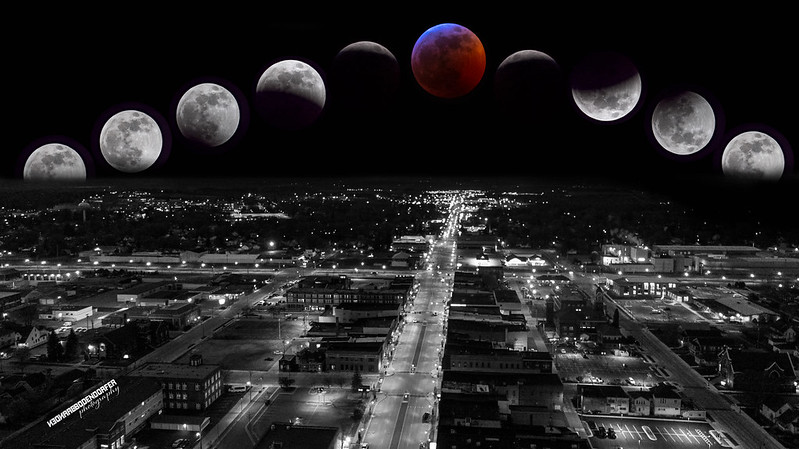
A “blood moon” is a term used to describe a total lunar eclipse when the Earth passes directly between the Sun and the Moon, casting its shadow on the lunar surface. During a total lunar eclipse, the Moon can take on a reddish or coppery hue, hence the term “blood moon.” This reddish coloration is caused by the Earth’s atmosphere scattering sunlight as it passes through, filtering out the blue wavelengths and allowing the longer red wavelengths to reach the Moon, creating the characteristic color. The intensity of the red color can vary depending on atmospheric conditions, such as the amount of dust and clouds present. Lunar eclipses, including blood moons, are safe to observe with the naked eye and are fascinating celestial events enjoyed by astronomers and skywatchers alike.
In this podcast, Branden Talks about how blood moon experience from his photography shoot.

Lunar eclipses occur when the Earth passes between the Sun and the Moon, causing the Earth's shadow to fall on the Moon. This celestial event can only happen during a full moon and can be either partial, total, or penumbral, depending on how much of the Moon enters the Earth's shadow.
During a total lunar eclipse, the Moon often appears red, a phenomenon known as a Blood Moon. This occurs due to Rayleigh scattering, where the Earth's atmosphere filters sunlight, allowing only the red wavelengths to reach the Moon. Such events are not only spectacular to observe but also provide valuable opportunities for astrophotography.
Capturing the beauty of a Blood Moon requires specific techniques and equipment to ensure stunning results. Photographers should consider using a tripod for stability, a telephoto lens for close-up shots, and a camera capable of manual settings to adjust exposure and focus.
Additionally, planning the shoot in advance by selecting a location with minimal light pollution can significantly enhance the quality of the photographs. Utilizing apps that track moon phases and positions can also help photographers time their shots perfectly for the best visual impact.
The Blood Moon has been a source of fascination and myth across various cultures throughout history. Many ancient civilizations viewed lunar eclipses as omens or signs from the gods, often associating them with significant events or changes.
In modern times, the Blood Moon continues to inspire awe and curiosity, prompting discussions about its scientific explanations and cultural interpretations. Understanding these perspectives can deepen our appreciation for this celestial phenomenon and its impact on human history.
For those interested in learning more about lunar eclipses and related astronomical events, a variety of podcasts and articles are available. These resources often feature expert interviews, discussions on the science behind lunar phenomena, and personal experiences from enthusiasts.
Branden Bodendorfer’s podcast offers insights into his experiences during lunar events, providing listeners with a unique perspective on both the technical and emotional aspects of observing the Blood Moon. Engaging with these materials can enhance your understanding and enjoyment of celestial events.