

The Morning Unlock: A 20-Minute Daily Planning Framework for Business Owners
You already have a morning routine. You get up early, you move, you read, maybe you write in a journal. You have done this for months. And you still finish a lot of days wondering what actually moved.
That gap is not a discipline problem. It is a design problem. Most business owners have fixed their mornings and never fixed their days. The routine improved. The results did not.
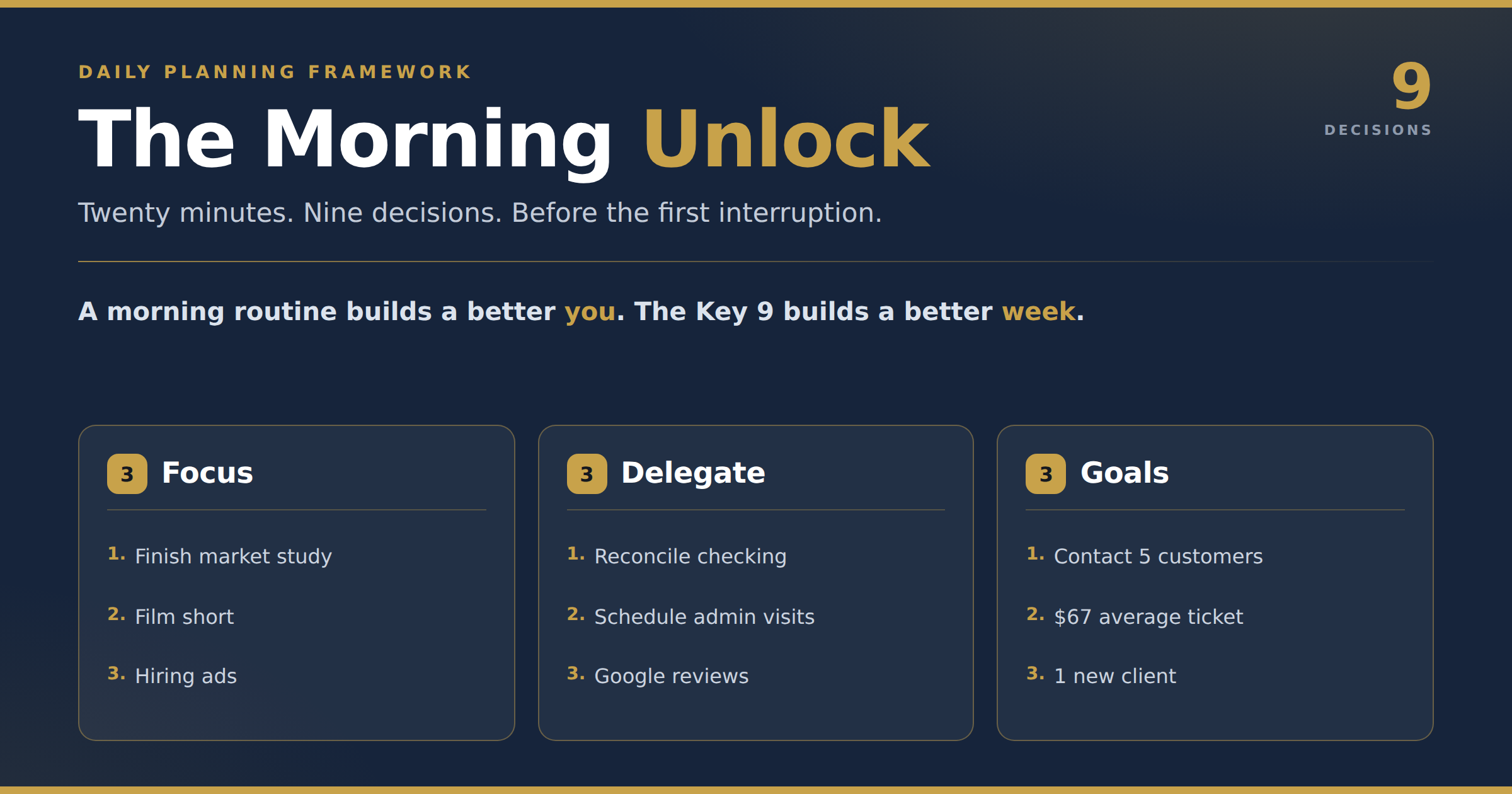
What follows is the fix I use in my own planning and teach in coaching. Nine decisions, made before the first interruption. I call the session the Morning Unlock and I call what it produces the Key 9: three Focus items, three Delegate items, three Goals.
Why your morning routine isn't moving your business
A routine improves the person, not the plan
Give the early-rising crowd their due. Movement, reflection, and reading before the world wakes up is a strong habit and it holds up under scrutiny. None of that is in dispute.

But look at what the hour actually contains. Every piece of it points inward. You are working on yourself. Nothing in that hour touches your pipeline, your team, or your numbers. So you arrive at 8 a.m. clear-headed and calm, open your inbox, and the day takes over anyway.
Michael Porter and Nitin Nohria logged 60,000 hours of 27 chief executives' time and concluded that the job runs on indirect levers. Strategy, culture, and people. Not on the leader's own two hands. A routine that only sharpens your hands is aimed at the smaller half of the job.
The three questions a routine never answers
Sit down tomorrow morning and try to answer these three before you open email:
- What am I actually moving today? Not what is on the list. What moves.
- What is my team moving while I do it? Work that happens without your hands on it.
- How will I know either one happened? A number, not a feeling.
Most people can answer the first one, badly. Almost nobody can answer the second. Nearly everyone skips the third. Those three questions are the whole framework, and answering them takes about 20 minutes.
What is the Morning Unlock?
The Key 9 at a glance
| Column | What you write | The question it answers |
|---|---|---|
| Focus | Three outcomes only you can move today | What did I actually do? |
| Delegate | Three handoffs to a partner, vendor, coworker, or employee | What moved while I worked? |
| Goals | Three numbers you control and will hit today | How do I know it counted? |
Why nine
Three is the number you can hold in your head without a system. Push past that and you start writing things down to keep track, which is fine, except most people only write down their own work. Nine covers all three levers. Your hands, your team's hands, and the evidence. And it still fits on one planner page.
A morning routine builds a better you. The Morning Unlock builds a better week.
From my experience. I have run this pattern for years, though not the way I teach it now. For a long time it lived in my weekly planning. Every week I would look at what was on my plate, sort out what mattered, and hand off what did not need me. That worked.
The daily version came out of coaching. Over the last several months I have walked entrepreneurs, business managers, and professionals through setting these nine every morning instead of every Monday, and the results have been better than I expected. What they report back is mental clarity. They know their top three. They know what is moving without them. They know the three numbers they are chasing. That combination is rare and it changes how the day feels by nine in the morning.
Focus: three things only you can move
The one-question filter
Ask it out loud. If today ended and only these three were done, did I move?
Yes means you picked right. No means you picked comfortable. Rewrite them.
This filter does something a priority ranking cannot. Ranking a list of twelve items still leaves you with twelve items and a vague sense that the top three matter more. The filter makes you name what a successful day looks like before the day happens.
The trap most people fall into
People pick the three fastest tasks, not the three heaviest. Fast tasks feel like progress. Checking four small boxes before 10 a.m. produces a real hit of momentum and almost no forward motion. Meanwhile the proposal you have been avoiding for nine days sits right where it was.
Simple rule of thumb: at least one of your three should make you a little uncomfortable. If all three feel easy, you built a warm-up, not a plan.
Delegate: three handoffs that build momentum
This is the column nobody else's morning routine has. It is also the one that changes a business fastest, and the one people resist hardest.
The payoff is measurable. Gallup studied 143 Inc. 500 CEOs and found that those with high delegator talent generated 33% more revenue in a year than those with low delegator talent, $8 million against $6 million. Same year, same list, different willingness to hand work off.
Your calendar is not your bottleneck. Your delegation queue is. A full calendar means you are busy. An empty Delegate column means you are the ceiling.
Delegate your weakest skill, not your longest task
This is where most people get it backward the first time through, and I did too. You assume delegation means offloading whatever is hardest or takes the most hours. It does not. The right thing to hand off is the work you have the weakest skill set for.
Think about what is actually in your tool bag. Some of those tools you are good with. Some you are passable with. And one or two you have been swinging badly for years because nobody else was around to swing them. That last group is your Delegate column.
The move is to find partners and vendors whose strengths sit exactly where your gaps are, then hand them the things that matter to you so they are pulling toward the same goal you are. I have watched this play out repeatedly in coaching sessions over the past several months. We map their strengths and weaknesses, they start delegating the work they are worst at, and the results compound.
The four-line handoff
The most common pushback I hear has nothing to do with willingness. Leaders want to delegate. What stops them is the mechanics. How do I instruct this person? How will they know what I actually want? That question is fair, and it has a short answer. Every delegation needs four lines:
- The outcome. What done looks like, in one sentence.
- The deadline. A date and a time, not "this week."
- The constraint. The budget, the tool, the boundary they should not cross.
- The check-in. When you will look at it, so nobody has to guess.
Write those four lines and the guesswork disappears. If you cannot write them, you do not have a delegation. You have a wish, and wishes come back to your desk.
One more rule that matters more than it sounds: send the handoffs during the session. A delegation you write at 6 a.m. and send at 4 p.m. is a task you kept for a full day.
What to do if you have no one to delegate to
The second piece of pushback is different. It is guilt. Leaders carry the weight of the operation, and adding work to someone else's plate feels like failing at the job. I understand that instinct. It is also the thing keeping your team from growing, because people build capacity by being handed things they have not done yet.
If you genuinely have no team, the column still works. Ask what partners, vendors, contractors, or AI tools you already have that could simplify the work, shorten the cycle time, or automate a step. A freelancer counts. A vendor counts. A workflow that runs without you counts. Reframe it as three things that move without my hands on them.
Goals: three numbers that prove the day counted
Pick numbers that fit your industry
Every owner needs their own set. The question to ask is simple: what measurement tells me this part of the day was successful?
| Industry | Daily numbers that tell you the day worked |
|---|---|
| Restaurant | Tables turned, guests through the door, tickets cashed out |
| Delivery and logistics | Stops made, packages delivered |
| Sales | Contacts connected, prospects reached, deals closed |
| Agency or service | Proposals sent, follow-ups closed, average ticket |
| Coach or creator | Sessions delivered, pieces published, list signups |
Track a number you control
Revenue is a number you hope for. Calls made is a number you control. Track the one you control and the other one follows.
Write the target next to the metric, not just the metric. "Contact 5 customers" is a goal. "Contact customers" is a reminder. The number is the whole point of the column.
Personal numbers belong here too. Miles run, steps walked, chapters read, minutes of focused work with the phone in another room. Mixing one health or growth number into a business day is what makes the habit survive past week two. It gives you a win that has nothing to do with work on the days when work does not cooperate.
If you cannot name three numbers you are moving today, you do not have a plan. You have a to-do list.
How to run your Morning Unlock
The session, minute by minute
Twenty to thirty minutes, start to finish. That is the whole commitment.
| Minutes | What you do |
|---|---|
| 0 to 5 | Review yesterday's score and today's calendar. Note what slipped and what is already committed. |
| 5 to 12 | Write your three Focus items. Run the filter on each one. |
| 12 to 22 | Write your three Delegate items using the four lines. Send them now. |
| 22 to 27 | Set your three Goals with a target next to each. |
Set it up in your planner
You need one page you return to every morning, and it needs to be the same page every time. Here is mine from a Tuesday, drawn straight onto a Key2Success Planner daily page.
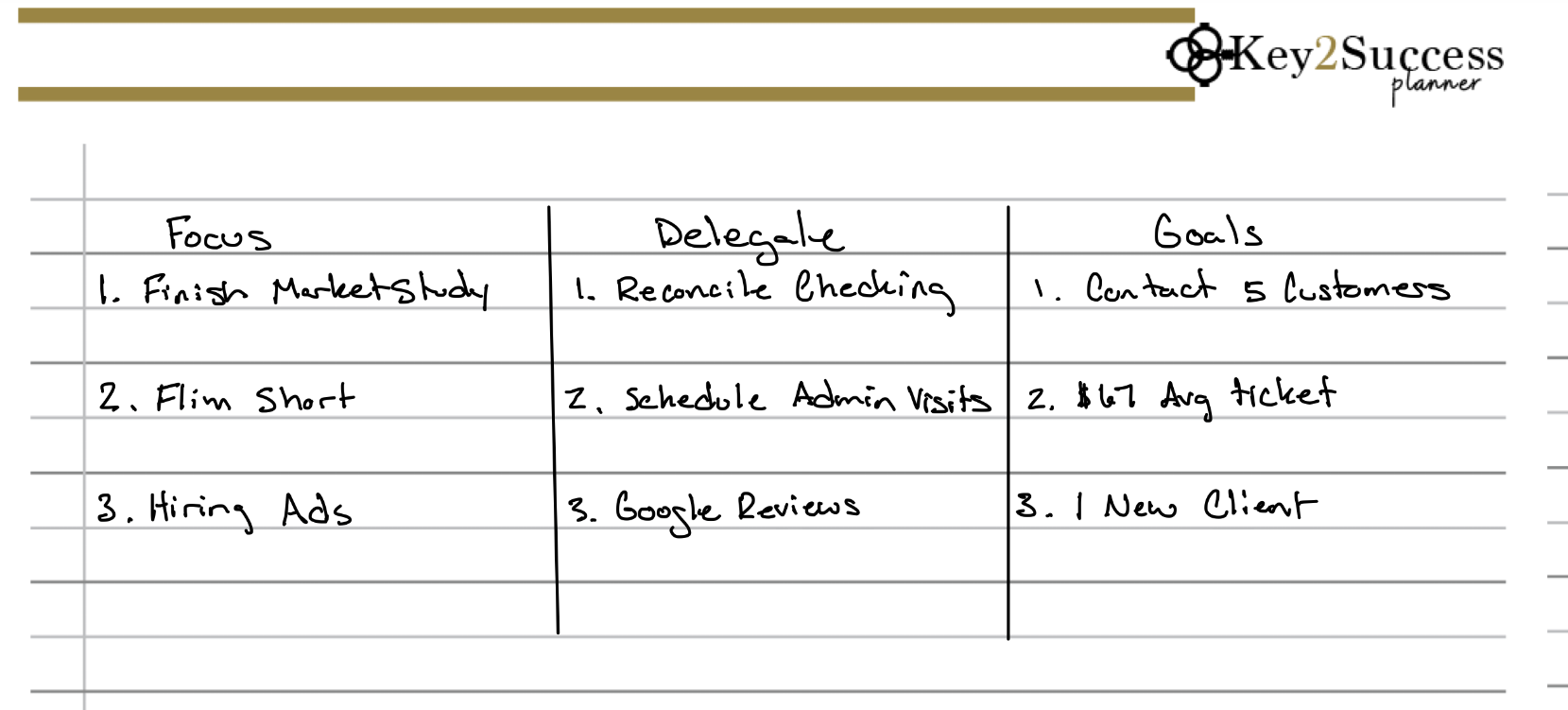
Notice the Delegate column. Reconciling checking and chasing Google reviews are not the hardest things on that page. They are the things I am worst at and should not be touching. That is the whole point of the column.
Setup takes about a minute. Draw two vertical lines on the daily page, label the columns Focus, Delegate, and Goals, and number one through three down each one. Do it once and copy the page forward. It works the same in OneNote, GoodNotes, reMarkable, and Samsung Notes. Paper works fine too. The system does not care about the tool. It cares that the page is the same page tomorrow.
The three-minute close
At the end of the day, score your Key 9 out of nine. Three Focus, three Delegate, three Goals. Mark what landed.
Do not chase nine out of nine. A steady six or seven every day beats an occasional perfect nine that costs you the following morning. The score is a signal, not a grade. If you keep scoring two in the Delegate column, that is the column to work on, and now you know it instead of guessing.
Run your first Key 9 tomorrow morning
Focus, Delegate, Goals. Three lines each, on the same page every day, in the app you already use.
Explore the Key2Success PlannerWhich method is right for you
| Morning Unlock | Daily to-do list | Time blocking | |
|---|---|---|---|
| Focus | Your work, your team, your numbers | Your tasks | Your calendar |
| Team leverage | Built in | None | None |
| Measurable daily | Yes, three numbers | No | No |
| Time to run | 20 to 30 min | 5 min | 15 to 20 min |
| Best for | Owners, leaders, small teams | Individual contributors | Protecting deep work |
These are not mutually exclusive. Plenty of people run the Morning Unlock at 6 a.m. and block their calendar around the three Focus items that come out of it. The Key 9 decides the work. Time blocking protects it.
Common questions
Quick answers
- Do I have to get up early?
- No. Run it whenever your day starts.
- Can I do this at night instead?
- Yes, though you lose the calendar check against today's actual commitments.
- What if I miss a day?
- Start again the next morning. Streaks are not the point.
- Does this replace time blocking?
- No. It decides what goes in the blocks.
- What if one Focus item takes a week?
- Write today's slice of it, not the whole thing.
- Can a whole team run this together?
- Yes, and the Delegate column becomes visible across the team when they do.
- Do I need a digital planner?
- No. Paper works. One consistent page is the requirement.
- What about a day that gets hijacked?
- Score honestly, carry the misses to tomorrow, move on.
- Can I use this for personal goals only?
- Yes. Swap business numbers for health, learning, or family metrics.
- How long before I notice a difference?
- Most people I coach report clearer mornings within the first couple of weeks.
- What if my Delegate items get rejected?
- Check your four lines. Vague handoffs come back.
- Should the three Goals change daily?
- Mostly no. Keep two steady and let one flex.
Frequently asked questions
What is the Morning Unlock?
Do I have to wake up at 5 a.m. to do this?
What if I do not have anyone to delegate to?
What KPIs should a business owner track daily?
How long does the Key 9 take each morning?
How is this different from a to-do list?
The Delegate column is where most leaders get stuck
Setting your own Key 9 is the easy part. Building the habit across a team is harder. Coaching covers what this article cannot: mapping your strengths and gaps so you delegate the right work, building the handoff habit with your actual team, choosing the numbers that matter for your business, and holding the system past week three when most people quit.
See the coaching programsNot ready for a program? Book a free 10-minute call and we will look at your Delegate column together.
- Business and Leadership Coaching \xe2\x80\x94 the full library of guides
- When Is the Right Time to Hire a Coach?
- Your First 90 Days as a New Manager
Branden Bodendorfer is a Wisconsin-based entrepreneur, productivity coach, and the creator of the Key2Success Planner. He coaches owners, managers, and professionals on planning systems that get implemented. See the full range of coaching and mentoring services.