

From Individual Contributor to Manager: How to Make the Leap
Here is the part nobody warns you about. As an individual contributor, you built your career on your own accomplishments, your output, your wins, your climb. The day you become a manager, all of that evaporates. After coaching people through this exact jump, the pattern I see is clear: the ones who struggle keep trying to be the best doer in the room, and the ones who thrive learn that their success now runs entirely through other people.
The hardest shift: your win is now their win
As an individual contributor, you took pride in your own accomplishments. Growing your status, advancing your career, being the person who delivered. That is exactly what earned you the promotion. Then you become a manager, and that scoreboard disappears.
The goal now is leading the team around you. Your success comes through their victories. Every accomplishment they achieve is a win for you. That sounds simple, but it is a genuine identity shift, and most new managers spend months quietly grieving the old scoreboard before they accept the new one.
The day you become a manager, your own accomplishments stop counting the way they used to. Your win is now their win.

Why your experience becomes a trap
Here is the trap, and it catches the strongest people hardest. You are the one with ten years of experience. You have been on the front lines. So you often feel you have the right answer, and you want to insert yourself into every conversation.
That instinct is understandable, and it is exactly what holds your team back. Every time you jump in with the answer, you take a growth opportunity away from the person you are supposed to be developing. The very expertise that earned you the promotion becomes the thing most likely to make you a mediocre manager.
The expertise that earned you the promotion is the thing most likely to sink you as a manager.
Step back and ask, do not answer
The managers who see the furthest success are the ones who step back, listen, and ask questions. They let their team provide input, wrestle with the problem, and grow. This is the single most underestimated part of leading versus doing: you have to step aside, ask more questions, listen for other people's input, and help navigate the team toward the right direction rather than dragging them there.
What this looks like in practice
- Ask before you answer. When someone brings you a problem, respond with a question. "What have you tried? What do you think we should do?"
- Let good-enough happen. If your team can do it 80 percent as well as you, let them do it. They will reach 100 percent faster by doing than by watching.
- Sit in the silence. After you ask a question, wait. The urge to fill the gap with your own answer is the habit to break.
- Coach the thinking, not just the task. Help them see how to approach the next problem, not only how to solve this one.
Build your bench
When you step back and let people grow, something powerful happens. You build your bench. Your team gets stronger, you reach collective goals you could never hit alone, and you create leaders instead of followers.
This is also how you advance. When you eventually move up or into a different role, a team you have developed can carry the torch long after you leave. A manager who is the single point of knowledge is stuck. A manager who has built a bench is promotable. The same habit that makes your team better also makes you the obvious candidate for the next role.
What to actually do first
- Have the goals conversation with each person. Learn what each team member wants, what they are good at, and where they want to grow. You cannot lead people you do not understand.
- Redefine your own scoreboard. Write down what success looks like for the team this quarter, and measure yourself against that, not your personal output.
- Delegate one thing you love doing. Give away a task you are great at. It signals trust and forces you out of the doer seat.
- Protect time to lead. Block time for one-on-ones and coaching. If your calendar is all doing, you have not actually made the jump.
The individual-contributor-to-manager shift
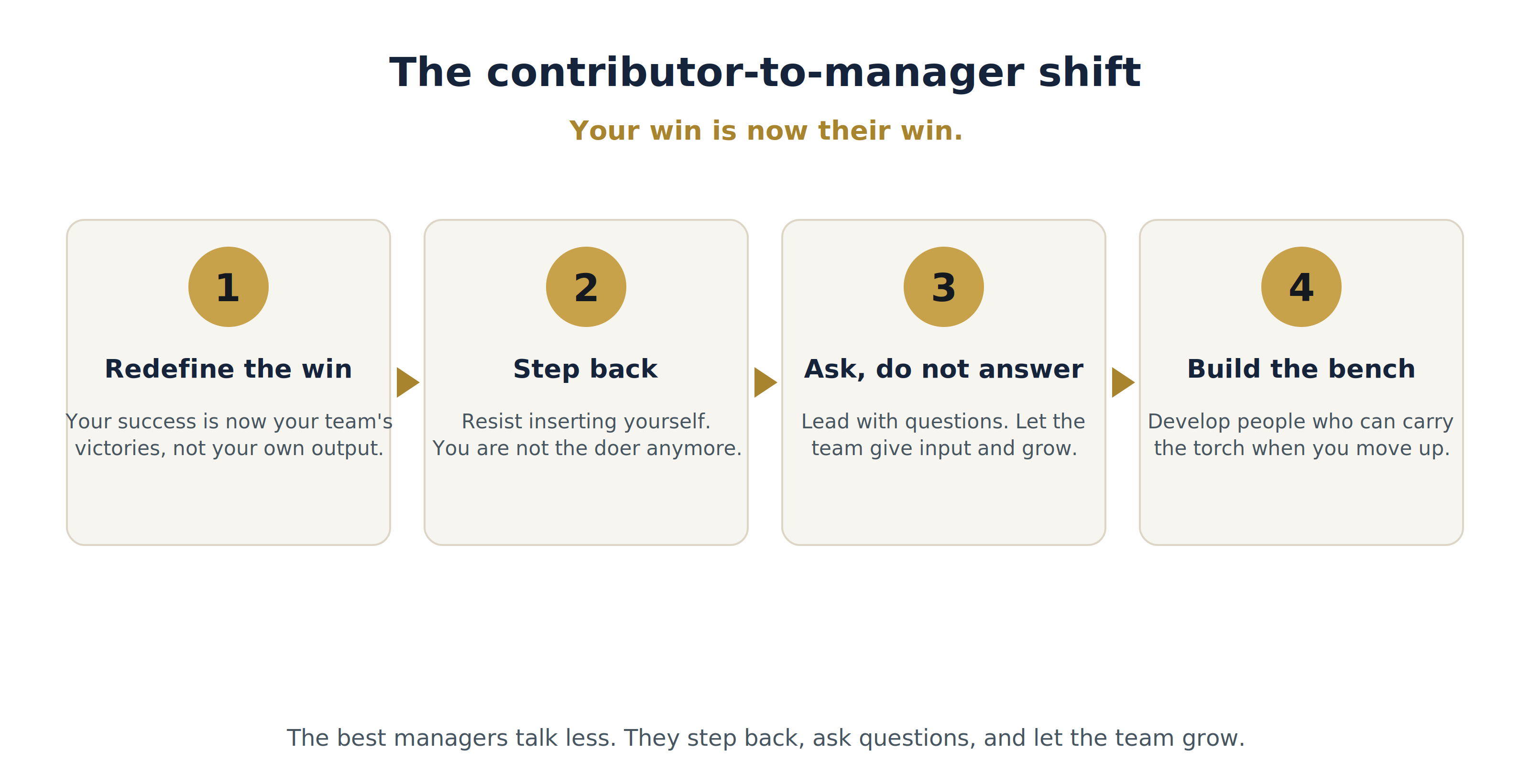
When I coach someone through this transition, four moves do the heavy lifting. Together they turn a strong doer into a strong leader, and they are the backbone of the Professional coaching program.
None of this is natural for a high performer, which is why so many great individual contributors become frustrated managers. It is a learnable skill, and it is worth learning, because it is the difference between being promoted once and being promoted again.
Just stepped into leadership?
Book a free 10-minute call. We will build your first-90-days plan and the habits that turn a strong doer into a strong leader.
Book a free 10-minute callQuick answers
- What is the hardest part of becoming a manager?
- Redefining success. Your own output stops being the scoreboard, and your team's victories become your win.
- Why do great individual contributors struggle as managers?
- Their expertise makes them want to insert their own answer, which stops the team from growing.
- Should I still do the work I was promoted for?
- Less and less. Delegating what you are great at is exactly how you make room to lead.
- How do I stop micromanaging?
- Ask before you answer, let good-enough happen, and sit in the silence instead of jumping in.
- What if my team does it worse than I would?
- At first they might. They reach your level by doing, not by watching you do it.
- How does letting go help my career?
- You build a bench that can carry the torch, which makes you promotable instead of stuck.
- What should I do in my first week as a manager?
- Have a goals conversation with each person and learn their strengths and ambitions.
- Is management a skill or a personality?
- A skill. It is learnable, even if it feels unnatural to a strong individual contributor at first.
Frequently asked questions
How do I transition from individual contributor to manager?
What is the hardest part of moving into management?
Why do strong performers make weak managers?
How do I avoid micromanaging my team?
How does developing my team help me get promoted?
Can a coach help me become a better manager?
- Business and Leadership Coaching \xe2\x80\x94 the full library of guides
- Your First 90 Days as a New Manager
- When Is the Right Time to Hire a Coach?
- How to Build a High-Performing Sales Team

Branden Bodendorfer is a business and leadership coach and the creator of the Key2Success Planning System. He coaches new and experienced leaders through the shift from doing the work to leading the people who do it, so their teams grow and their careers keep moving. See his coaching programs.