

How to Lead Your Team Through a Reorganization
A reorganization does not fail because the org chart is wrong. It fails because the leader forgets the pieces. After coaching leaders through restructures, the pattern I see is consistent: the ones who struggle go quiet and hope the plan speaks for itself, and their people fill the silence with fear. The ones who win hold a clear vision, communicate it relentlessly, and put the right people in the right seats as the change happens.
Why reorganizations really break down
Here is what actually happens to a team during a restructure. People feel threatened. They feel concerned. And they do not see the whole picture for what it is. Often they are not being used the right way, or no one has had a conversation with them about their goals. So they stop pushing for the same vision everyone else in the room is pushing for, and they get off on a different path, because they cannot see how all these realigned pieces are supposed to come together.
Underneath that is fear. Fear that the change will not work. And too often the leader makes it worse by holding back, staying quiet, and not sharing the information they really should. This is not about leaking confidential details. It is about keeping the goals, the outcome, and the vision in the forefront where everyone can see them.
A reorganization does not break because the plan is bad. It breaks because fear fills the silence the leader leaves behind.

Start with vision, not the org chart
Before you move a single box on the chart, get clear on what the restructure is actually trying to achieve. A real leader carries that vision and can say, in plain terms, what the organization looks like on the other side of this and why it is worth the disruption. Without that, you are just rearranging people, and they will feel it.
The vision is the anchor for everything that follows. Every role conversation, every goal, every hard call during the reorg should trace back to it. When people can see the destination, the change stops feeling like something happening to them and starts feeling like something they are part of.
Give every person a role and a goal
One of the biggest failures I see is leadership forgetting the individual. In the middle of moving the structure, they never sit down with each person and answer two questions: what is your role in this, and what are your goals through it. People who cannot answer those two questions are the ones who drift.
- Name the role. Tell each person exactly where they fit in the new structure and why they are there.
- Set the goals. Give them clear goals for the reorganization itself, not just their day job, so they know what winning looks like during the change.
- Connect it to the vision. Show them how their piece fits the bigger picture, so they are pushing the same direction as the room.
Name strengths, name gaps, then equip
A restructure is the moment to be honest about talent. A good leader can identify the strengths each team member brings and define their weaknesses, not to punish anyone, but to put people in the right seat. That is the whole game: equip each person with the right tools and place them where their strengths actually count.
When you know your people this well, you can also spot who in the room can help you carry the change. Those are the people you lean on to push the cause, set goals, and hit milestones. You are not doing this alone, and you should not try to.
Your job in a reorg is not to move boxes. It is to put the right people in the right seats and hand them the right tools.
Communicate the cause, not just the change
As the change happens, most leaders explain what is changing. Fewer explain why. You have to do both. Emphasize the benefits of the change and the cause behind it: here is what we are doing, and here is the real reason we are doing it. The cause is what earns buy-in. The what, on its own, just creates anxiety.
Take the moment to reflect out loud, too. Be able to say, through this change, here is what we have already seen improve. Naming early progress keeps the vision credible and reminds people the disruption is producing something real.
Share the wins as you go
This is where a good leader wins the reorganization. You already have the vision. You know the boulders, the real challenges you are facing through the restructure. You know your team's strengths and gaps. So as you set milestones and start hitting them, share those victories with the people around you.
Every win you share out loud does two things: it proves the vision is working, and it excites the team to keep moving. Momentum in a reorg is not automatic. You build it, one shared win at a time.
The framework I coach leaders through
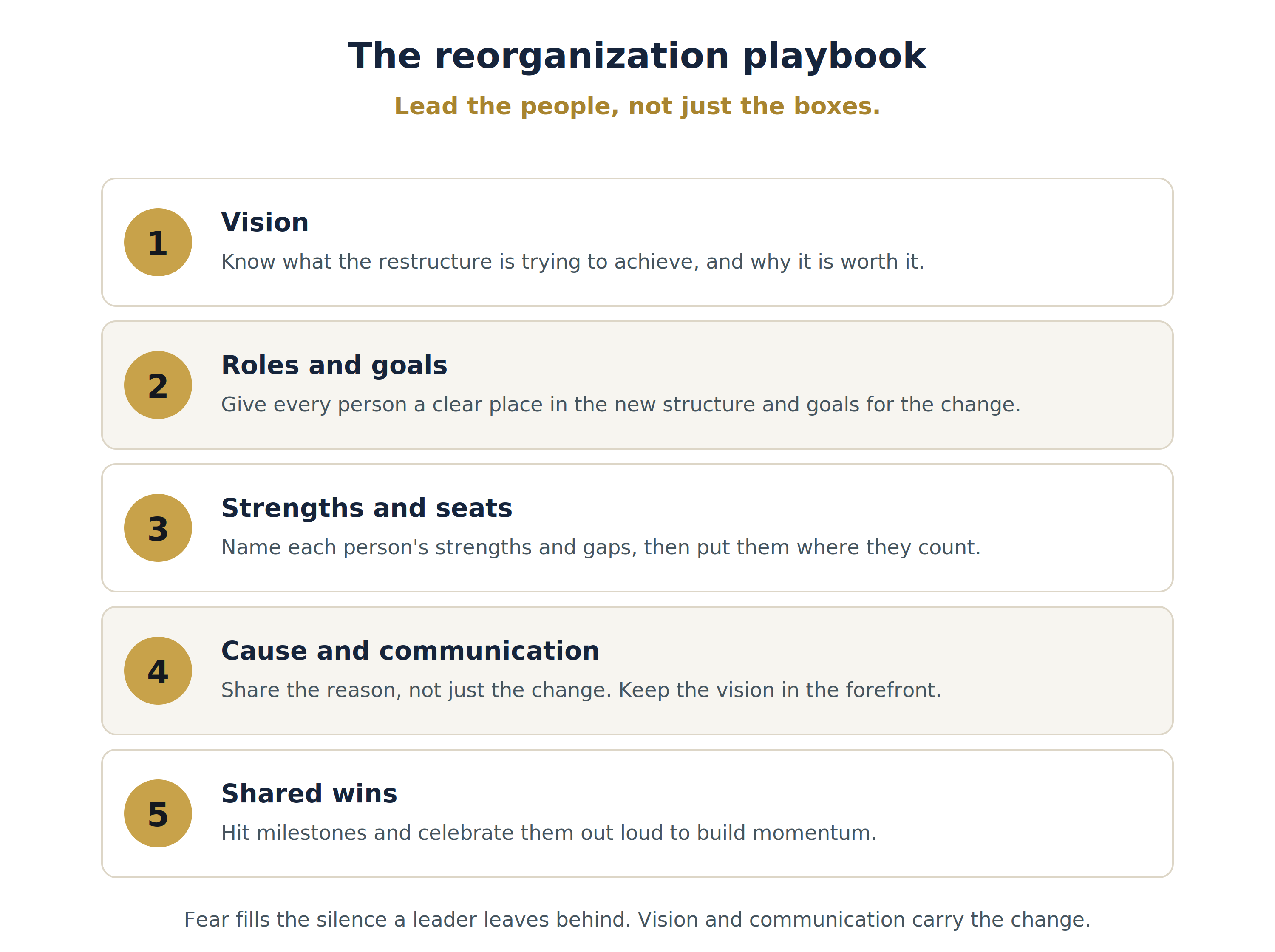
When I coach a leader through a restructure, we do not start with the boxes. We start with the vision, then work outward to the people. The same five moves carry almost every reorganization, and they are the backbone of how the Executive program and the Business Development program equip leaders to lead through change instead of just surviving it.
Leading a team through change right now?
Book a free 10-minute call. We will pressure-test your vision and build the plan to carry your team through it.
Book a free 10-minute callQuick answers
- What is the first thing to do in a reorganization?
- Get clear on the vision. Know exactly what the restructure is trying to achieve and why, before you move anyone.
- Why do reorganizations fail?
- Usually not because of the structure. They fail when people feel threatened, cannot see the whole picture, and the leader goes quiet.
- How much should I tell my team?
- Keep the goals, outcome, and vision in the forefront. You do not share confidential details, but you never let silence do the talking.
- How do I keep good people from leaving?
- Give them a clear role, real goals, and a seat that uses their strengths. People rarely leave a change they can see themselves in.
- What do I do about employees who resist?
- Often they resist because no one connected their role to the vision. Have the conversation about their goals and where they fit.
- How do I keep momentum during a long reorg?
- Set milestones and share every win out loud. Naming what has already improved keeps the vision credible and the team energized.
- Should I involve my team in the plan?
- Yes. Identify the people who can help carry the cause, set goals, and hit milestones. You should not lead the change alone.
- How do I handle my own fear as the leader?
- Anchor to the vision and focus on what you can control: clarity, communication, and putting people in the right seats.
Frequently asked questions
How do I lead my team through a reorganization?
Why do most reorganizations fail?
What should a leader communicate during a restructuring?
How do I keep my best people during a reorganization?
How do I rebuild momentum and morale during change?
Can coaching help me lead through a reorganization?

Branden Bodendorfer is a business and leadership coach and the creator of the Key2Success Planning System. He coaches executives and business owners through reorganizations, launches, and growth, using a planning framework that keeps vision, roles, and milestones aligned through change. See his coaching programs.