
Your brain on handwriting: the science that changes how you should plan
A 2024 study published in Frontiers in Psychology found that writing by hand triggers widespread brain connectivity across memory, sensory, and learning regions. Typing the same words produced almost none of that activity. If you want ideas and plans to stick, writing them down by hand is not optional. It’s how your brain actually encodes information.
Most people who switch to digital planning do it for convenience. Everything in one place, synced across devices, searchable, shareable. Hard to argue with that list.
But a Norwegian neuroscientist just closed a 20-year argument, and the answer is not what the productivity app industry wants you to hear.

Writing by hand changes your brain in ways that typing physically cannot. And if you’re serious about retention, decision-making, and actually following through on your plans, that matters more than any feature set.
What the study actually found
Dr. Audrey van der Meer at the Norwegian University of Science and Technology in Trondheim has been researching brain activity and writing for two decades. The paper that finally settled the debate was published in January 2024 in Frontiers in Psychology.
Her team fitted 36 university students with 256-sensor EEG caps and flashed words on a screen one at a time. Students either wrote each word by hand using a digital pen or typed it on a keyboard. Every neural response was recorded across the full five seconds the word was visible.
The results were stark.
When students wrote by hand, the brain lit up across multiple regions simultaneously. Memory, sensory integration, spatial reasoning, and the encoding of new information all fired together in a coordinated pattern that spread across the entire cortex.
When the same students typed the same word, that network almost completely collapsed.
Same person. Same word. Two completely different neurological events.
Why typing lets your brain coast
The reason gets at something most of us have never thought about. Writing by hand is not one motion. It’s a sequence of thousands of micro-movements, each letter requiring a different shape, a different spatial problem for your brain to solve. Your fingers, wrist, vision, and spatial processing are all coordinating in real time to produce one letter, then the next.
Typing throws that away entirely. Every key requires the exact same motion regardless of the letter. The brain has almost nothing to integrate and almost no problem to solve. It processes the word, but it doesn’t really work for it.
Van der Meer put it plainly: pressing the same key with the same finger over and over does not stimulate the brain in any meaningful way.
A decade earlier, researchers Pam Mueller and Daniel Oppenheimer at Princeton found the same answer from a different angle. Students who took lecture notes by hand significantly outperformed laptop note-takers on comprehension questions. The reason had nothing to do with the notes themselves. Handwriters couldn’t keep up verbatim, so they were forced to listen, filter, and put ideas in their own words. That act of choosing what mattered was the learning. The keyboard had quietly skipped it.
What this means for your planning practice
Here’s the practical translation: every goal you’ve typed instead of written went into your brain through a thinner pipe. Every task list you’ve tapped out, every priority you’ve keyboarded in, every intention you’ve captured on your phone instead of on paper was processed at reduced depth.
That’s not a memory problem. That’s a writing method problem.
The good news is you don’t have to choose between digital convenience and the cognitive benefits of handwriting. The Key2Success Planner was built around this exact tension.
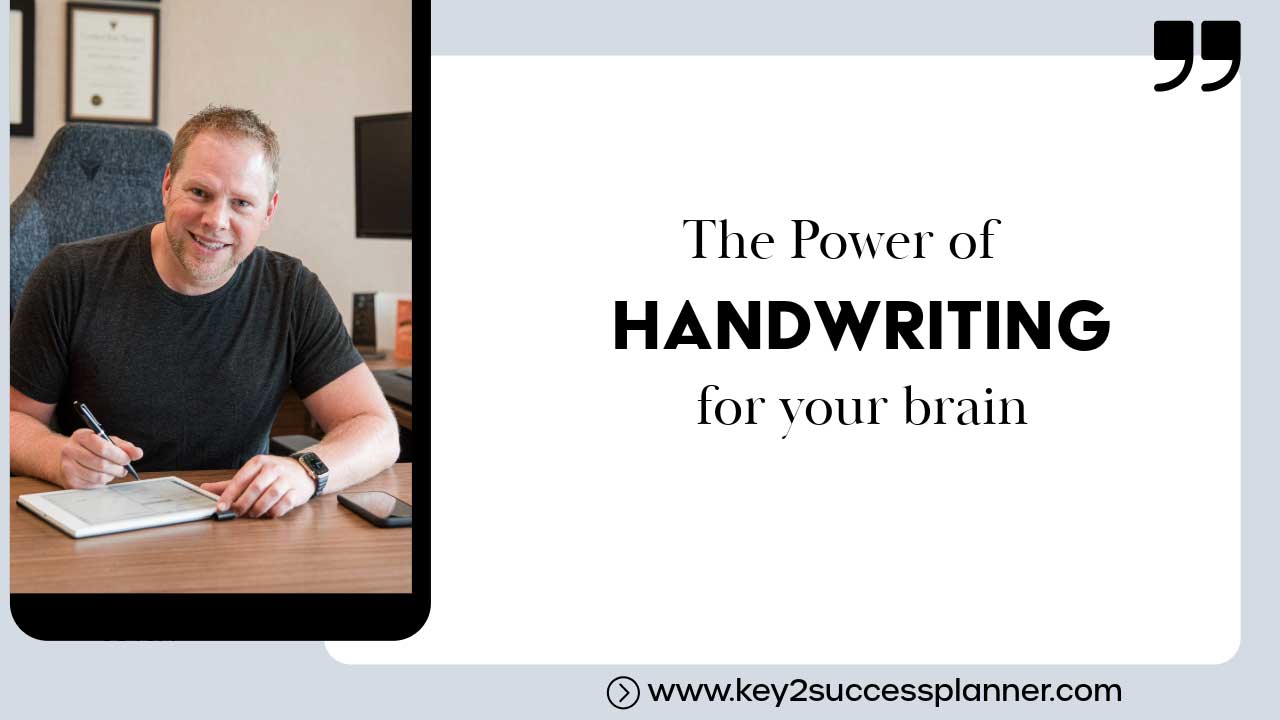
The planner runs on the devices you already carry. iPad, Surface, Samsung Tab, or any stylus-enabled tablet. You write by hand with your Apple Pencil or stylus directly on the digital page, which means your brain gets the full neurological workout of handwriting while your plans stay digital, synced, and searchable. You’re not going back to paper notebooks. You’re getting the brain benefits of handwriting inside the digital system you actually live in.
Write your weekly priorities by hand. Write your daily intentions by hand. Write the ideas that matter by hand. Let the keyboard handle the things that don’t need to stick.
The devices that make this work
The Key2Success Planner is compatible across the major stylus platforms:
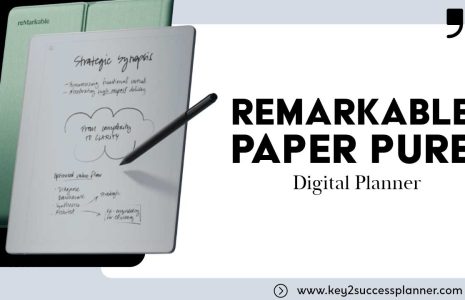
iPad with Apple Pencil — the most seamless handwriting experience, with pressure sensitivity and near-zero lag on GoodNotes or Notability.
Microsoft Surface with Surface Pen — strong option for Windows users who live in OneNote or PDF annotation workflows.
Samsung Galaxy Tab with S Pen — the most capable Android option, with native handwriting support built directly into the device.
Any of these paired with the Key2Success Planner gives you what van der Meer’s research says your brain actually needs: the motor complexity of handwriting, combined with the organizational structure of a real planning system.
The habit that changes everything
You don’t need to overhaul your whole workflow. Start with one thing.
Pick up your stylus every morning and write your top three priorities for the day by hand. Not typed, not voice-noted, not swiped. Written. It takes about 90 seconds. Your brain will process those three things differently than anything you’ve keyboarded this week. They’ll be more likely to actually happen.
That’s what the science says. That’s what your grandmother already knew. The slower road is the faster one.
Ready to write the way your brain actually learns?
The Key2Success Planner is built for stylus-enabled devices so you get the cognitive benefits of handwriting inside a modern digital planning system.
Frequently asked questions
Yes. The key factor is the motor complexity of forming letters with a pen-like instrument. Digital stylus writing engages the same fine motor and spatial processing pathways as writing on paper.
No. The research points to a targeted benefit. Use handwriting for things you want to remember and follow through on. Typing works fine for things that don’t need to stick as deeply.
You get the handwriting benefits with none of the friction. Your plans are searchable, backed up, and accessible across devices. You write by hand inside a structured system designed around goal-setting and daily execution.
iPad with Apple Pencil is the most popular combination, but it works well on Surface and Samsung Galaxy Tab with an S Pen. Any stylus-enabled device that runs GoodNotes, Notability, or PDF annotation apps will work.
The van der Meer study is published open-access: Van der Weel FR and Van der Meer ALH (2024), “Handwriting but not typewriting leads to widespread brain connectivity: a high-density EEG study with implications for the classroom.” Frontiers in Psychology, doi: 10.3389/fpsyg.2023.1219945.