

How to Launch a New Product or Service
Launching a new product or service is hard, especially if you have not launched in your market before. After bringing products and services to market myself and coaching owners through their own launches, the pattern I see is almost always the same. The launch does not fail because the vision is too small. It fails because people over-anticipate the results and commit money, materials, and people to numbers they only hoped for. The fix is to run the whole launch off milestones.
The mistake that sinks most launches
Most launch failures are not really product failures. They are forecasting failures. Someone builds a strong vision, assumes the market will show up in force, and then buys inventory, hires people, and pours money into marketing to be ready for a wave that has not arrived yet. When the early numbers come in slower than the dream, they are stuck with cost they cannot cover.
Vision is good. You should have a strong vision through the whole pipeline. But the vision is the destination, not the forecast. The forecast has to come from something more honest than hope.
A launch rarely dies from a small vision. It dies from getting over your skis, spending, buying, and hiring ahead of results you have not earned yet.

Study the market before you forecast
Before you set a single number, study your marketplace, your audience, and the segment you are in. Then look hard at your competition. How did their content perform? How fast did they accelerate to market? What kind of traction did a launch like yours actually produce? Their results are the most honest forecast you have, especially when you have no launch history of your own to lean on.
Base your expectations on what the market has actually shown, not on the best case in your head. That single discipline takes most of the over-anticipation risk off the table before you spend a dollar.
Your competitor's launch is the most honest forecast you have.
Set milestones, not just a vision
Once you have a realistic read on the market, break the launch into clear milestones. Each milestone is a specific, measurable achievement, and every one has a set of actions attached to it. The milestones are what keep the vision honest.
Make them concrete. For a service, it might be booking 10 new customers, then 25, then 50. For a product, it might be selling 1,000 units, then 5,000, then 10,000. The exact numbers depend on your market study. What matters is that each one is a real gate you either reach or you do not.
Gate every action behind a milestone
This is the heart of it. Attach your commitments to each milestone, and only unlock the next set of actions when you actually hit the gate. When you cross a milestone, that is your signal to take the next steps, which might be:
- Communicating with your vendors about the next production run.
- Sourcing more raw materials to match real demand.
- Adding marketing spend now that you know what converts.
- Adjusting your audience based on who is actually buying.
Do it this way and you see results in real time, and you never get over your skis in any one area. You do not buy too many raw materials, you do not overspend on marketing, and you do not staff up with people you cannot yet keep busy. Each commitment is earned by a result, not by a hope.
Set your action steps against milestones you hit, not the results you hope for.
Adjust in real time
Milestones do more than pace your spending. They give you honest, real-time feedback. If you blow past a milestone, you accelerate with confidence because the demand is proven. If you stall short of one, you have caught it early, while your exposure is still small, and you can adjust the offer, the audience, or the message before it gets expensive.
That is the whole point of running a launch this way. You curve your action steps to what is actually happening, so every step stays meaningful and proportional to the results in front of you.
The milestone-gated launch
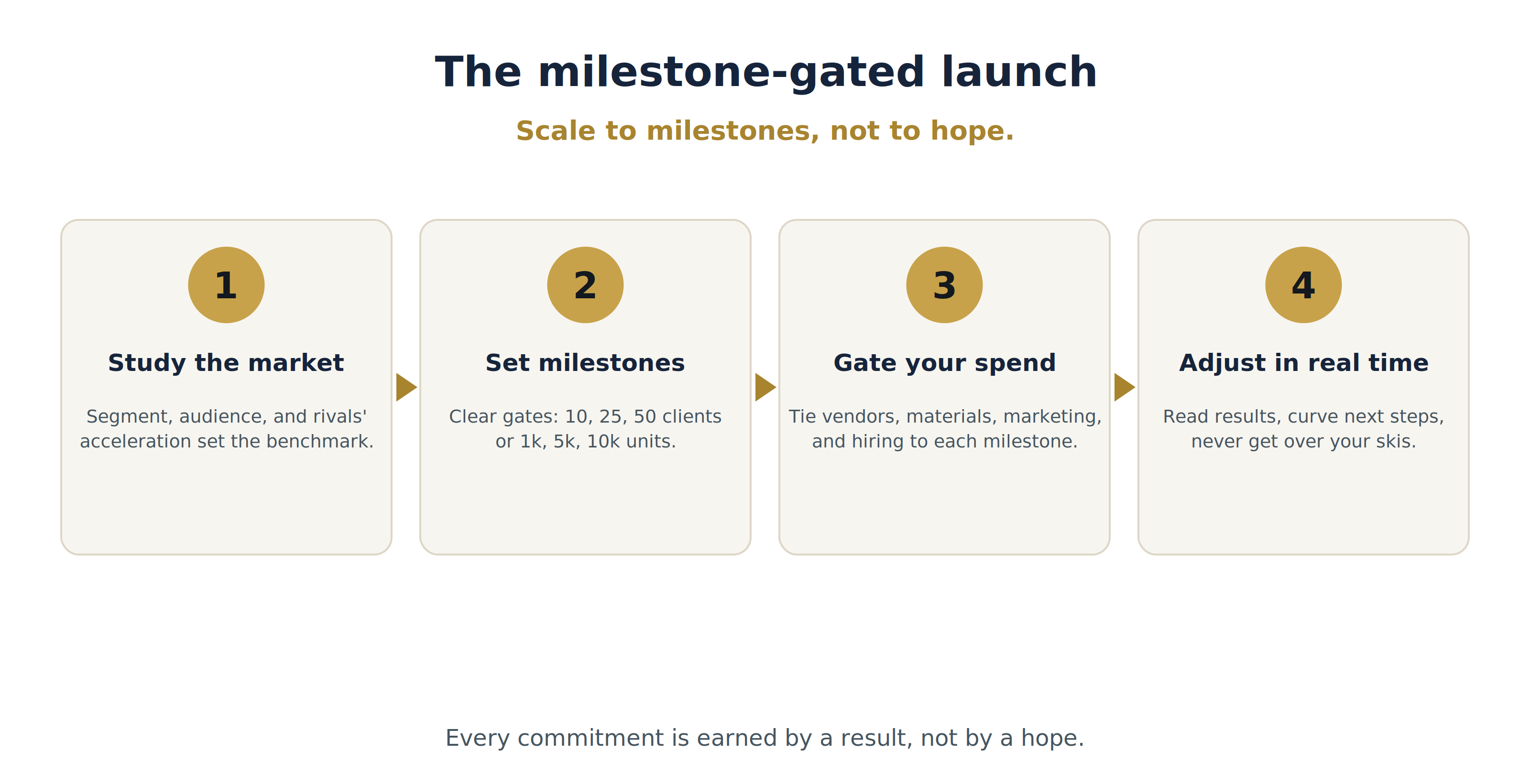
Here is the approach in one view. It is the same framework I walk owners through in the Business Development coaching program.
A launch built this way is not slower. It is steadier. You keep the ambitious vision, and you protect the business while you chase it. If a launch is one of the big moves in front of you, it is also one of the clearest signals that it is time for a coach.
Planning a launch?
Book a free 10-minute call. We will map your milestones and the action plan behind each one, so you launch with ambition and without getting over your skis.
Book a free 10-minute callQuick answers
- What is the biggest mistake in a product launch?
- Over-anticipating results and scaling spend, inventory, and hiring to hopes instead of to real demand.
- How do I forecast a launch with no history?
- Study competitors in your segment. How their content and acceleration to market performed is your most honest benchmark.
- What should launch milestones look like?
- Concrete and measurable, like 10, 25, then 50 customers, or 1,000, 5,000, then 10,000 units.
- What does it mean to gate spend behind milestones?
- Only unlock the next commitments, vendors, materials, marketing, hiring, when you actually hit a milestone.
- How do I avoid getting over my skis?
- Tie every action to a result you have already reached, so you never buy, spend, or hire ahead of demand.
- Do I still need a big vision?
- Yes. Keep the ambitious vision. Just let milestones, not hope, decide when you spend to chase it.
- What if I miss a milestone?
- You caught it early, while exposure is small. Adjust the offer, audience, or message before it gets expensive.
- When should I add marketing spend?
- After a milestone tells you what converts, so you are scaling something proven rather than guessing.
Frequently asked questions
How do you launch a new product or service?
What is the most common reason product launches fail?
How do I forecast results for a launch when I have no experience?
What are good launch milestones?
How do I keep a launch from draining cash?
Can a coach help me plan a launch?
- Business and Leadership Coaching \xe2\x80\x94 the full library of guides
- How to Build a High-Performing Sales Team
- How to Lead Your Team Through a Reorganization

Branden Bodendorfer is a business and leadership coach and the creator of the Key2Success Planning System. He has brought products and services to market and coaches owners through launches, helping them set realistic milestones and gate every action to results instead of hope. See his coaching programs.