
Planning Tips
Hobonichi Digital Alternative: Moving Your Techo to a Planner That Actually Syncs
Yes, you can replace a Hobonichi Techo with a digital planner. The closest Hobonichi digital alternative is the Key2Success Planner, which recreates a searchable daily and weekly layout inside apps you already use, syncs the same pages across your phone, tablet, and computer, and connects each day back to your goals. The official Hobonichi Techo App is a companion to the paper book, not a cross-device planning system.

The Techo is a beautiful daily book. A digital alternative keeps the daily rhythm and adds search, sync, and a line back to your goals.
On this page
If you are searching for a Hobonichi digital alternative, you have probably already filled a Techo or two and run into the same wall most fans hit: the book is wonderful to write in, but it does not search, it does not sync, and every January you start over with a blank one. This page is an honest look at what moves cleanly from a Hobonichi Techo to a digital planner, what does not, and which Key2Success layout maps to the spread you already love.

Here is the thesis up front. Most Hobonichi users who go looking for a digital version reach for the official Hobonichi Techo App, and for most of them it is the wrong tool. It keeps you inside the same yearly-book loop. The reason to go digital is not to carry the Techo on a screen. It is to make your planning searchable, portable across every device you own, and tied to the goals the Techo was never designed to track.
What the Hobonichi Techo gets right
Let us be fair to the Techo, because a page that trashes it will not earn the trust of anyone who loves it. Hobonichi got real things right. The Tomoe River paper is thin, light, and takes fountain pen ink better than almost anything on the market. The A6 daily grid gives you one clean page per day with a quote at the bottom, which turns a planner into something you look forward to opening. The Weeks format, a slim week-on-the-left and grid-on-the-right, is one of the best pocket layouts anyone has ever printed. And the yearly index plus the monthly calendars make the paper book genuinely usable if you stay on top of it.
None of that is in question. The Techo is a great daily organizer. The gap shows up the moment your planning needs to do more than hold today.
Where Hobonichi users hit friction
Hobonichi users most often go digital for three reasons: they cannot search a paper book for an old note, the Techo does not sync across their phone, tablet, and computer, and they have to buy a new book and start empty every year. A digital planner solves all three by keeping searchable, synced pages that carry forward automatically.
The friction is not the layout. It is what the paper cannot do once your life gets busy.
You cannot search it. This is the one that pushed me out of paper years ago. When you know you wrote something down but cannot remember which day, a paper book makes you flip. A digital planner in an app like OneNote or GoodNotes lets you search your own handwriting and find it in seconds.
It does not sync. The Techo lives in one place, in your bag. If you plan at your desk and review on the couch, the book is only ever in one of those spots. A digital planner shows the same page on every device you own.
You start over every January. A new Techo is a blank book. Every recurring commitment, every running list, every note you want to keep gets rewritten by hand or left behind. Going digital means your pages, notes, and tasks carry forward without you copying anything.
It has no line back to your goals. The Techo is built around today. It was never designed to connect a yearly vision to a quarterly plan to this week to this morning. That connection is the whole point of a professional planning system, and it is the piece paper planners leave out.
The Hobonichi Techo App vs a true digital planner
Hobonichi did release an official Hobonichi Techo App on iOS and Android, timed to the Techo’s 25th year. It is a real product and it is nicely made. It is also a companion to the paper book, not a replacement for it and not a cross-device planning system. It keeps you inside the Hobonichi format and the Hobonichi ecosystem. It does not turn your planning into searchable, goal-linked pages you can run from any app on any device.
That is the honest distinction, so here it is side by side. The Techo wins a few rows outright, and I have marked those.
| What matters | Hobonichi Techo (paper + app) | Key2Success Planner |
|---|---|---|
| Paper feel and fountain pen ink | Hobonichi wins | Digital, no paper |
| Works with no battery | Hobonichi wins | Needs a charged device |
| Search your own notes | No (paper); limited (app) | Yes, searchable handwriting |
| Same layout on phone, tablet, and computer | No | Yes, identical on every device |
| Pages and tasks carry forward year to year | Rewrite by hand | Carry forward, no rewriting |
| Vision linked to quarterly, weekly, and daily plans | No | Yes, the core of the system |
| Daily priority framework | Open daily grid | Daily Key 3 |
| Customize and build your own pages | Fixed format | Yes, with Tiles |
| Cost pattern | New book every year | Yearly edition, notes carry over |
What you give up going digital
An honest switcher page has to say this part out loud, because you will feel it in the first week. You give up the paper. Tomoe River under a fountain pen is a real pleasure and a screen does not reproduce it. You give up the no-battery reliability of a book that always opens. You give up a little of the tactile memory effect, the way your hand remembers where on the page you wrote something. And if you have invested in Hobonichi covers, pen loops, and accessories, that sunk cost stays on the shelf.
For some people that trade is not worth it, and that is a fair answer. If your planning is mostly a daily ritual and you rarely need to search, sync, or connect it to bigger goals, keep your Techo. The people who switch and stay switched are the ones whose planning has outgrown a single book in a single bag.
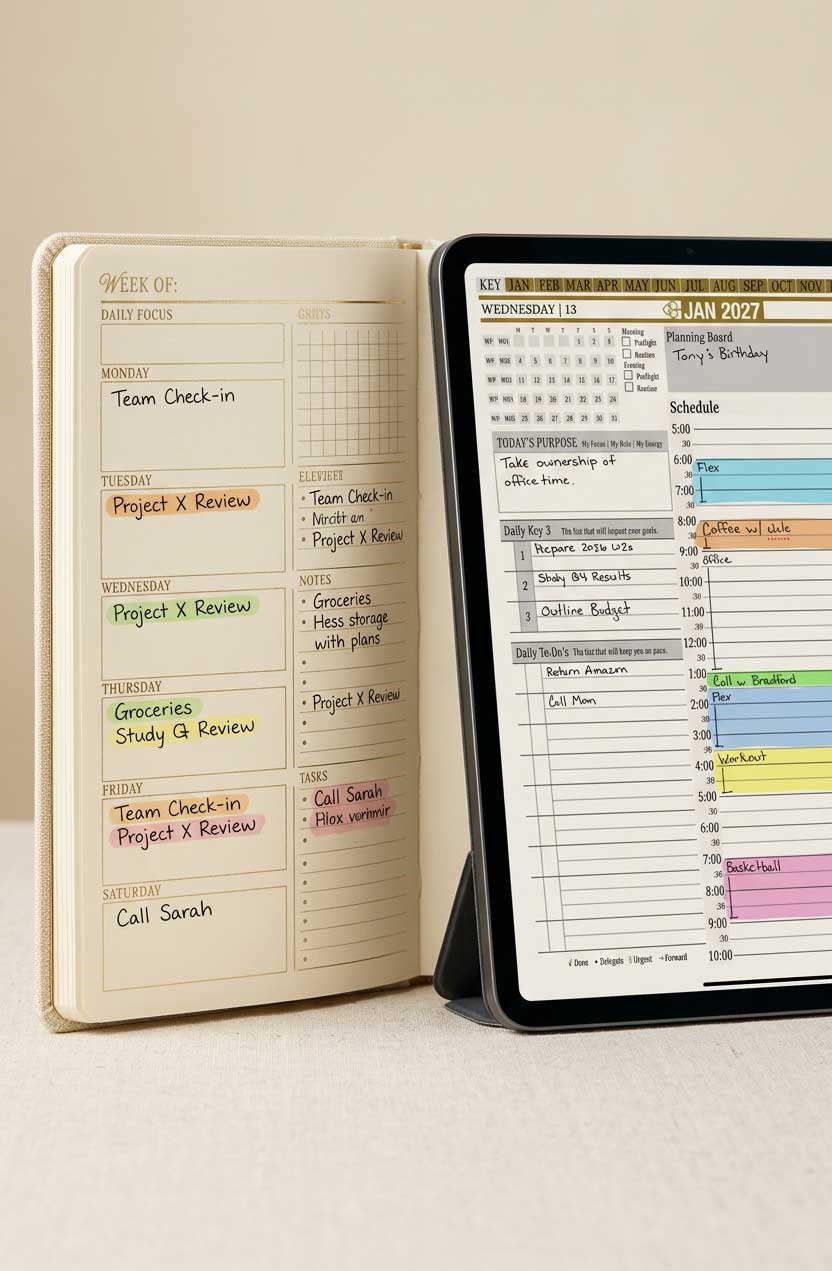
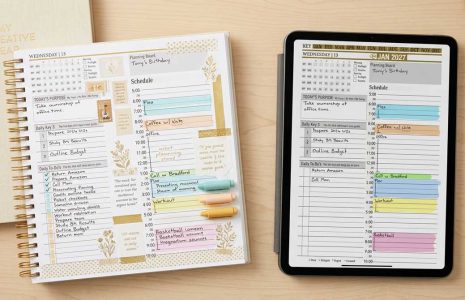
A paper weekly spread beside the Key2Success daily view. The weekly page is the planning foundation a paper book never connects back to the day, and the Daily Key 3 is where that connection happens.
How a Hobonichi user moves to Key2Success, step by step
Generic migration advice is useless here, so this is specific to your book.
Map your layout first. If you use the Hobonichi Weeks, the closest match is the Key2Success weekly horizontal layout. If you use the A6 Techo with its page-per-day, you will feel at home in the daily layout, with the weekly page sitting above it as the planning foundation the Techo never had.
Pick the device you already know. This is the most common question our support inbox gets, so start here. Use the tablet or computer you are most comfortable with, then decide which other devices you want it to sync across. The Planner Finder quiz matches you to the planner and app that will sync across the exact devices you own.
Move your fixed commitments, not the whole book. You do not transcribe a year of Techo pages. You carry forward the things that repeat and the forward-dated commitments you have not reached yet: birthdays, renewals, recurring meetings, goals with a deadline. Everything past is already done.
Finish the paper year alongside, if you want. Nothing says you have to abandon the current Techo mid-year. Plenty of people run the digital planner forward from today and let the paper book finish out its year as an archive.
Watch the setup videos before you judge it. This is the single biggest predictor of whether the switch sticks. The Getting Started series walks you through installing on one device, letting it finish syncing, then adding the rest. The most common setup problem is people adding three devices at once before the first one has synced.
Which Key2Success edition fits a Hobonichi user
Do not overthink the edition. Most Hobonichi users land on the Personal or Professional edition, which is the tier that lines up with what paper planners already give you: daily, weekly, monthly, and a vision board, all connected. If your planning carries real professional weight, the Business or Executive edition adds planning tools that no paper book offers. And if the thing you loved about the Techo was making it your own, the Tiles system lets you build your own pages, which is the one feature no paper planner and no Hobonichi app can match.
I did not come to digital from Hobonichi. I came from Franklin Covey and then the Full Focus Planner, and the breaking point for me was not the layout or the paper. It was that I could not find what I had written. After years of paper planning I had a stack of books and no way to search them. Digital gave me back searchable notes and the ability to move a task from one day to the next without rewriting it. The Hobonichi users who come into the Key2Success community tell a version of the same story: they love the daily ritual, they never wanted to leave it, and they finally hit the day where the book could not keep up with what their planning had to do.
Start your Hobonichi digital alternative
The Key2Success Planner runs in the app you already use. See the full planner and pick your edition on the Key2Success Planner page, or jump straight to the version for your app: GoodNotes, OneNote, or reMarkable.
Move from Hobonichi to Key2Success in 5 steps
- Match your Techo layout to a Key2Success layout (Weeks to weekly horizontal, A6 daily to the daily layout).
- Choose the device you know best, then list the devices you want it to sync across.
- Run the Planner Finder quiz to confirm the planner and app that fit those devices.
- Install on one device and let it finish syncing before you add the others.
- Carry forward only your recurring and forward-dated commitments, then plan this week on the weekly page first.
Hobonichi digital alternative FAQ
Can I replace my Hobonichi Techo with a digital planner?
Yes. A digital planner like Key2Success recreates the daily and weekly rhythm of the Techo inside apps you already use, then adds search, cross-device sync, and a connection to your goals. You keep the daily habit and gain the things paper cannot do.
Does Hobonichi have an official digital app?
Yes. Hobonichi offers the official Hobonichi Techo App on iOS and Android. It is a companion to the paper book that keeps you inside the Hobonichi format. It is not a cross-device planning system, and it does not link your daily pages to quarterly and yearly goals the way a professional planner does.
Does the Key2Success layout change depending on my device?
No. The Key2Success template is built so the layout, the look, and the action steps are identical on every device. Your planner looks and works the same on your phone, your tablet, and your computer.
Which Key2Success layout is closest to the Hobonichi Weeks?
The Hobonichi Weeks maps most closely to the Key2Success weekly horizontal layout, with a week view for scheduling and space alongside it for notes and tasks. The A6 page-per-day Techo maps to the daily layout.
What happens to my notes at the end of the year?
Unlike a paper Techo, where you start a blank book each January, a digital planner carries your notes, lists, and unfinished tasks forward without rewriting them. You move to the new year with your history intact instead of leaving it behind on a shelf.
Common questions from Hobonichi switchers
The takeaway
Here is the contrarian part. For a Hobonichi user who wants to go digital, the official Hobonichi Techo App is usually the wrong choice, because it keeps you inside the same yearly-book loop that sent you looking in the first place. The reason to leave paper is not to carry the Techo on a screen. It is to make your planning searchable, portable, and connected to the goals the Techo was never built to hold. Keep the daily ritual you love. Put it on a system that can keep up with the rest of your life.
About the Author
Branden Bodendorfer is the creator of the Key2Success Planner, used by professionals in 52 countries, and a digital planning pioneer who has been building planning systems since 2013. His work has been featured on ABC World News, the NBC Today Show, ESPN, CNN, and Disney.
Sources
- Hobonichi Techo App, official listing, Apple App Store and Google Play
- Hobonichi Techo product line, Hobonichi official store